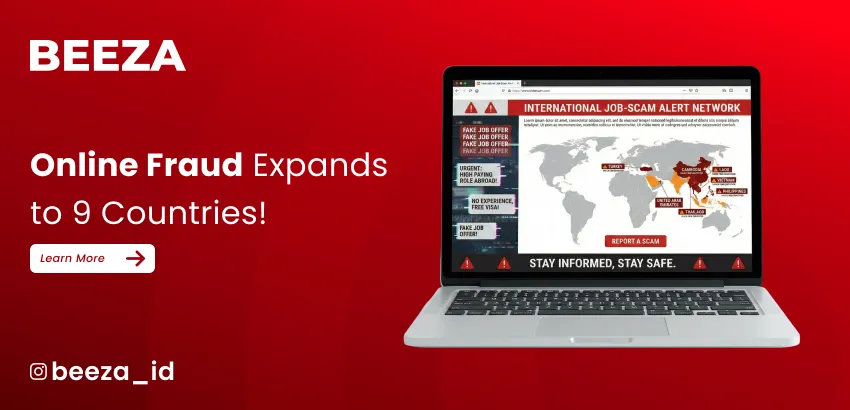
Indonesia’s Ministry of Foreign Affairs (MoFA) revealed that online scam cases have spread to at least nine countries, not just Cambodia. The schemes are increasingly complex — from fake job offers to digital exploitation and human trafficking — showing that cyber threats today are not only about financial loss but also about human safety and dignity.
As the digital world grows more connected, data security and identity verification have become the new shield protecting both individuals and institutions.
Cyber Fraud Goes Global
In its statement on October 20, 2025, MoFA confirmed that Indonesian citizens have fallen victim to transnational online scams operating in Cambodia, Myanmar, Laos, Thailand, Vietnam, the Philippines, the UAE, and Turkey.
Most of these victims were lured through fake job postings on social media, promising high salaries and comfortable living conditions — only to be trapped in overseas compounds and forced to conduct cyber fraud operations.
These fraudulent schemes are part of a larger, well-coordinated cybercrime network that leverages social media platforms, encrypted messaging, and stolen data to expand their reach.
Old Tricks, New Technology
The methods may be old, but the tools are cutting-edge.
Criminals now use deepfake technology, automated bots, and cloned websites to deceive victims and bypass traditional security checks.
Some victims reported that their biometric data and facial images were stolen and later used to create fake accounts or impersonate others online.
According to Interpol’s 2025 report, over 60% of cross-border scams involve leaked biometric or verification data from insecure platforms.
This shows that protecting personal data is not just a cybersecurity issue — it’s a matter of maintaining digital trust on a global scale.
The Economic and Social Fallout
These scams are not isolated incidents — they have wide-reaching economic and reputational impacts.
As Indonesia accelerates its digital transformation, particularly in the fintech and startup ecosystems, maintaining public trust in the digital economy has become a top priority.
When private data is leaked or misused, the damage extends beyond individuals.
Businesses lose credibility, consumer confidence plummets, and the overall digital economy suffers.
Data from Indonesia’s National Cyber and Crypto Agency (BSSN) recorded over 32 million cyberattacks in the first half of 2025, with identity-based scams being among the most prevalent.
The Need for Verified and Ethical Digital Identity
This growing threat underscores the urgency of secure and ethical identity management.
Organizations that handle customer data must ensure that digital verification (e-KYC) processes are transparent, compliant, and protected by multi-layered authentication.
Advanced tools such as face matching, liveness detection, and encrypted digital signatures have become the cornerstone of preventing impersonation and fraud.
Beyond compliance, these solutions help organizations build digital trust — the new currency of online interactions.
MoFA’s Call for Digital Awareness
In its briefing, the MoFA stressed that digital literacy and public education are crucial to combating the rising tide of online fraud.
The government urges the public to be cautious of online job offers, verify company identities, and avoid sharing personal data carelessly.
The ministry is also collaborating with foreign authorities to rescue victims, strengthen cross-border cooperation, and tighten cybersecurity policies.
Building Digital Trust Amid Cyber Turbulence
The global spread of online scams serves as a stark reminder that trust and identity protection are the foundation of every digital interaction.
As cybercriminals grow more sophisticated, businesses, startups, and institutions must go beyond surface-level security to build resilient systems that foster long-term trust.
A Smarter, Safer Path with Verified Digital Solutions
In an era where cyber threats evolve faster than ever, businesses must adopt secure, ethical, and efficient digital identity verification systems.
Beeza offers an end-to-end solution for e-KYC, face matching, liveness detection, digital signatures, and authentication, ensuring every digital interaction is verified and protected.
With Beeza, organizations can build lasting digital trust — turning security into a competitive advantage.