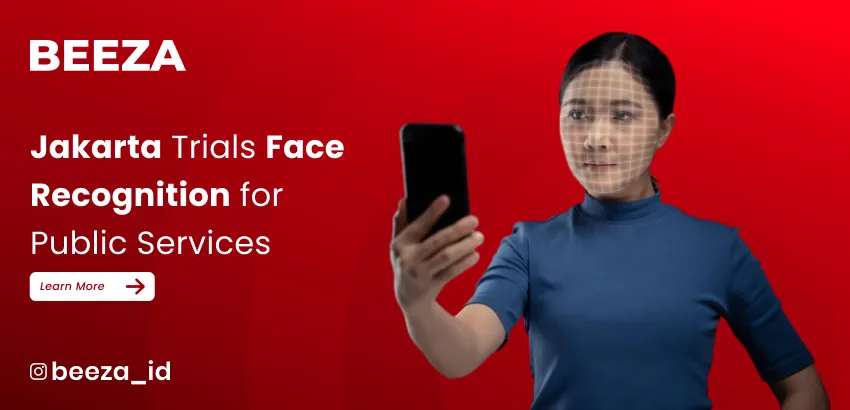
Jakarta’s latest smart city initiative introduces facial recognition for daily public services. But while it promises convenience, it raises critical questions about biometric data security, user privacy, and system transparency.
Smart Cities Need Smart Verification
The Jakarta government has begun piloting a facial recognition system for public services, marking a major step in its smart city transformation. From public transportation to parking and even local tax payments, Jakarta residents may soon be able to access services using nothing more than their face. But with this innovation comes significant public concern: How secure is biometric data? And is the system ready for wide-scale, ethical implementation?
Jakarta’s Digital Leap Toward Smart City Integration
As part of its digital transformation, the Jakarta Provincial Government announced on July 12, 2025, that it is testing facial recognition technology across various public service touchpoints. The pilot aims to streamline citizen verification and improve the efficiency of government services.
Key use cases include:
- Automated check-ins at TransJakarta and LRT stations
- Touchless digital parking payments in high-traffic zones
- Identity verification for local tax or retribution payments via government apps
- Seamless access to other NIK-based public services
This initiative is part of a broader smart city vision that prioritizes automation, integration, and digital accessibility for all residents.
“We aim to build a user-friendly, technology-driven Jakarta. Facial recognition is a gateway to more integrated and responsive public services,” said Arif Rachman, Head of Jakarta’s Communication and Informatics Office.
Efficiency, Speed, and Reduced Contact: The Promises of Face Recognition
Facial recognition technology offers several key advantages:
- Faster service delivery: No need for physical IDs or manual login
- High accuracy: Biometrics are harder to fake than passwords or cards
- Touchless experience: Suitable for post-pandemic public hygiene concerns
- Cross-sector integration: From transportation to public health systems
Globally, facial recognition is seeing widespread adoption. According to MarketsandMarkets, the facial recognition market is projected to reach USD 16.7 billion by 2028, up from USD 5.4 billion in 2022 — a clear sign of growing confidence in its utility across public and private sectors.
The Rising Tide of Concern: Privacy and Data Security
Despite the benefits, there are growing concerns about the ethical implications of deploying facial recognition in public spaces, especially where regulations are still evolving.
1. Biometric Data Is Irreplaceable
Unlike passwords, your face can’t be changed. If biometric data is stolen or leaked, it can be exploited for identity theft or fraud indefinitely. The high sensitivity of this data demands advanced encryption and security practices.
2. Mass Surveillance Risks
Without strict oversight, public facial recognition systems can lead to unconsented mass surveillance. Citizens may unknowingly have their movements tracked or recorded, undermining civil liberties.
3. Regulatory Gaps in Indonesia
Although Indonesia passed the Personal Data Protection Law (UU PDP), detailed technical guidance regarding biometric data storage, user rights, and system audits remains limited. The legal infrastructure hasn’t yet caught up with the pace of technological deployment.
“Smart cities must be about smart governance, not just smart tech,” said Laily Maulida, a digital rights researcher at ICT Watch. “Accountability, transparency, and citizen rights should be at the core.”
Algorithmic Bias and Discrimination
Multiple studies — including one from MIT Media Lab — have revealed that some facial recognition systems exhibit bias, particularly against women and people of color. These biases arise when AI is trained on non-diverse datasets, leading to incorrect identification or denial of access to public services.
For instance, a system might reject a legitimate user because their facial features are underrepresented in the training data. In public services, this could result in exclusion or unjust administrative consequences, especially for marginalized groups.
How to Implement Facial Recognition Responsibly
If Jakarta is to lead by example, it must embrace not just innovation, but also ethical and secure design principles. Key recommendations include:
a. Liveness Detection Integration
Systems must incorporate AI-powered liveness detection to ensure the user is physically present and not using a photo, video, or deepfake. This helps prevent fraud and abuse of the system.
b. Multi-Factor Authentication (MFA)
Combining facial recognition with secondary verification — like a PIN or one-time password (OTP) — adds a safety layer for sensitive services, such as tax payments or medical records.
c. Transparent Audit Trails
Every identity verification process must leave a traceable digital footprint. Users should be able to review where, when, and how their facial data is used.
d. Localized, Encrypted Storage
Biometric data should be stored in secure local servers, not overseas, and encrypted to industry standards such as ISO/IEC 27001.
Smart Technology Needs Smart Tools: The Role of Beeza
In light of these challenges, solutions like Beeza offer a robust alternative. Beeza provides:
- AI-based facial recognition with real-time liveness detection
- Legally certified digital signatures
- Transparent, auditable verification processes
- Custom API integrations for public institutions and enterprises
Designed to prioritize user privacy, Beeza supports smart city ecosystems with compliant, ethical, and secure digital identity tools.
Conclusion: Building Trust into Smart Cities
Jakarta’s facial recognition initiative is a bold move toward smarter public service delivery. But the long-term success of such technology hinges not only on its functionality, but also on public trust. Without responsible implementation, strong regulation, and robust privacy measures, the risks may outweigh the benefits.
A truly smart city doesn’t just optimize systems — it protects its people. And that begins with ethical governance, transparent technologies, and secure digital identities.Looking for a secure and compliant solution to implement biometric authentication in your organization? Discover how Beeza can help at beeza.id