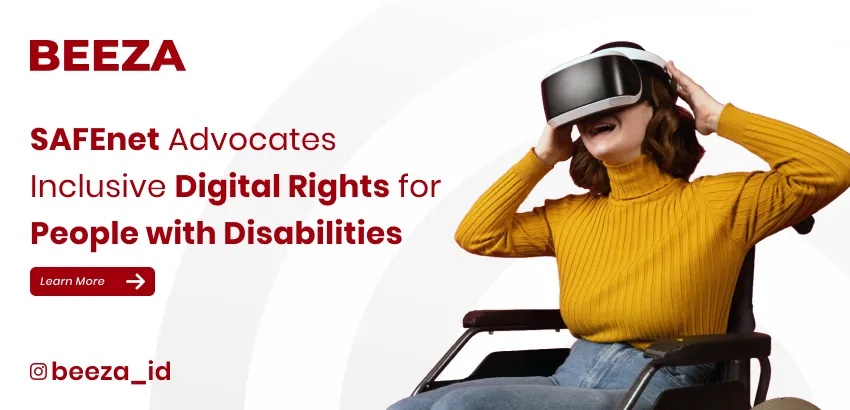
Bridging the Digital Divide SAFEnet for Persons with Disabilities Amid Rapid Technological Growth
Despite rapid advances in digital technology that increasingly shape everyday life, many people with disabilities still face significant barriers in accessing the internet and digital services on an equal footing. Challenges such as non-accessible website design, lack of tailored accessibility features, and digital policies that overlook disability needs have left this community marginalized within the digital domain.
Recognizing this gap, the Southeast Asia Freedom of Expression Network (SAFEnet) has taken a vital role in promoting the fulfillment of inclusive digital rights for persons with disabilities in Indonesia. For SAFEnet, equitable access to information, meaningful participation in digital spaces, and protection from discrimination based on physical or sensory impairments are integral human rights in the digital era.
Since the internet is the emerging public sphere, it is imperative that all individuals—regardless of physical, sensory, or intellectual limitations—have the opportunity to enter and engage actively within digital environments. SAFEnet insists that digital inclusion is not a discretionary add-on but an essential obligation for governments, corporations, and all digital stakeholders.
Data and Findings Highlighting Accessibility Gaps for People with Disabilities in Indonesia
Together with the UK Embassy in Jakarta, SAFEnet recently released research assessing the accessibility of Indonesian government public service websites for people with visual disabilities. The study involved participants with complete blindness and low vision testing government portals and found that the majority failed to meet the globally recognized Web Content Accessibility Guidelines (WCAG) 2.1 AA standard, which ensures content usability for users with disabilities.
Many government websites lacked compatibility with assistive technologies such as screen readers and did not feature sufficient navigational aids for visually and hearing-impaired users. This limits disabled users’ access to essential public services including violence reporting, education registration, and socio-economic information.
Between August 2024 and July 2025, SAFEnet, supported by a £38,000 (~IDR 835 million) grant from the UK Digital Access Programme (DAP), ran the Inclusive Digital Rights project. This included tailored digital rights and security training modules designed specifically for deaf communities and those with visual impairments.
SAFEnet’s Inclusive Approach: Community-Led Capacity Building and Accessible Learning Tools
A key characteristic of SAFEnet’s programs is the participatory model that empowers persons with disabilities as trainers, consultants, facilitators, and beneficiaries. Training modules were developed with accessible pedagogy tailored to real needs, including the creation of a Sign Language Glossary containing crucial digital rights terminology to assist the deaf community’s learning.
A signature achievement is the development of an accessible version of the gender-based violence reporting website Awas KBGO, now compatible with screen readers and a range of assistive technologies that facilitate seamless reporting for people with disabilities.
This hands-on involvement builds empowerment and ownership within the community, ensuring technology and programs are not only designed for but also by the disabled.
Challenges and Opportunities in Advancing Inclusive Digital Rights and Policies
Despite progress made, major challenges persist such as the lack of comprehensive digital accessibility legislation and insufficient awareness among policymakers and developers regarding disability needs.
SAFEnet advocates for active engagement of disabled communities in shaping legislation, digital technology design, and policymaking to produce meaningful, effective, and contextually appropriate inclusive solutions.
“Digital transformation must be built from the ground up through inclusive collaboration,” emphasizes Nenden Sekar Arum, Executive Director of SAFEnet, “to leave no one behind amid technological advancement.”
Technology as a Cornerstone for Digital Inclusion and Identity Protection: Beeza’s Role
Alongside policy and education, robust and inclusive digital identity verification technology is crucial for facilitating access while safeguarding personal data privacy for persons with disabilities.
Beeza provides a blockchain-based biometric identification platform offering liveness detection and real-time authentication. Its secure, transparent system allows only legitimate users to access digital services without limiting accessibility, helping bridge gaps in the digital ecosystem.
By integrating Beeza’s solution, digital services can both enhance security and empower disabled users by simplifying inclusive identity verification.
Conclusion: Inclusive Digital Rights as a Collective Responsibility
SAFEnet underscores that guaranteeing digital rights for people with disabilities is an urgent human rights issue in achieving social justice within digital spaces. Inclusive technological development and policy reforms can and must be co-created with the communities they serve.
Indonesia’s continued commitment to expanding digital inclusion initiatives is vital to building a national ecosystem where everyone—regardless of ability—can equally benefit from digital opportunities and protections.
Make inclusive access a priority. Embrace trusted digital identity technology like Beeza to support and protect the digital rights of all citizens. Visit beeza.id today for secure, inclusive digital identity solutions.